
This is Part 1 of a two-part blog series for beginners to karting with CKNZ. It covers the essential tools you should carry to the track as a minimum, with Part 2 covering a more comprehensive toolkit for those wanting to be fully prepared for trackside maintenance and repairs. This list has been compiled based on the most commonly used tools and sizes for Era 4 (1980s), Era 5 (1990s) and Era 6 (2000s) karts, which are the most prevalent among our members.
Part 2 covers an expanded toolkit, including more specialist tools that you generally won’t need when starting out. These can often be borrowed from fellow karters when required, helping to keep your initial costs down. You can always add these tools to your collection as your experience grows and your needs change.
Images are provided for reference purposes only.
Minimal
ALLEN (HEX) KEY SET
There are three common types of Allen keys (hex keys): L-shaped, T-bar (fixed or sliding), and foldable pocket sets. For karting, I recommend avoiding the foldable type, as they are generally less convenient for regular workshop use.
Start with a complete set of L-shaped metric Allen keys ranging from 1 mm to 10 mm. The 5 mm and 8 mm sizes are particularly useful and are among the most commonly used on a kart.
If your budget allows, consider adding a second set with sliding T-bar handles. These provide greater flexibility, and the sliding handle allows you to adjust your grip and apply more leverage when tightening or loosening socket-head screws.
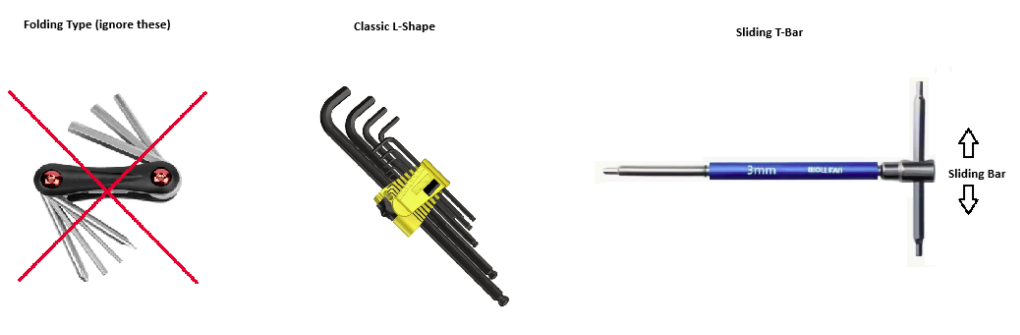
Ball-end Allen keys are also worth considering. They allow you to turn screws at an angle, making them especially useful when access is restricted. Some L-shaped sets include ball ends on one side, as shown in the image below.
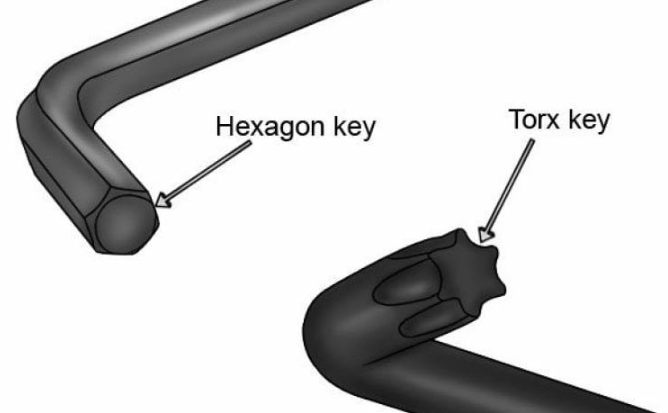
Note: Don’t mistake these for Torx keys. Torx are also handy to have but you’ll primarily use Allen keys with your kart.
SOCKET SET
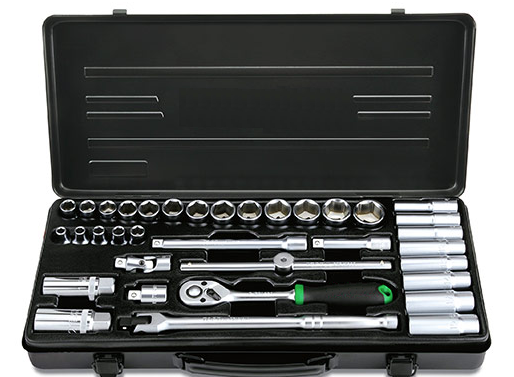
A metric socket set with a 3/8-inch drive is best suited to karting (the ‘drive’ is the square fitting that connects the socket to the ratchet handle) If you don’t have a complete set, aim to have at least the following socket sizes: 8 mm, 10 mm, 13 mm, 17 mm, 19 mm and 22 mm.
If buying, look for a set that includes a swivel joint, which helps you access fasteners in tight or awkward spaces. Deep sockets, as shown on the right in the image below, are generally unnecessary for a basic karting tool kit.
The 13 mm socket will likely see the most use, so consider purchasing a second one separately to save time when working on your kart.
Avoid buying the cheapest set available. Lower-quality kits often have weaker ratchet mechanisms, which can be the first component to fail with regular use.
Finally, make sure your set includes a 16 mm hex-size spark plug socket. You’ll remove and replace the spark plug regularly, making this one of the most frequently used specialist sockets in your karting toolkit. For more information, see our guide to NGK spark plugs.
SCREW DRIVERS
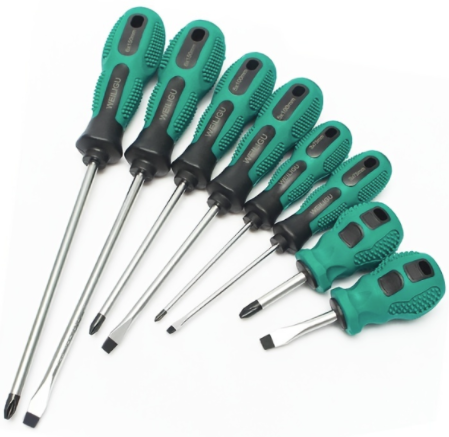
A quality set of flat-head and Phillips-head screwdrivers is useful for kart maintenance. Although they are generally used less frequently than sockets and spanners, several components on your kart will require them.
Aim to have three sizes of each type:
- Phillips-head: PH1 for small screws and clamps, PH2 for general-purpose kart maintenance, and PH3 for larger screws.
- Flat-head: 3 mm tip for small adjustment screws, 5 mm tip for general-purpose work, and 6.5 mm tip for larger screws and clamps.
A stubby screwdriver, with a short handle and shaft, is also handy for accessing screws in tight spaces where a standard screwdriver won’t fit. Ideally, have one in both Phillips and flat-head varieties..
SPANNER SET
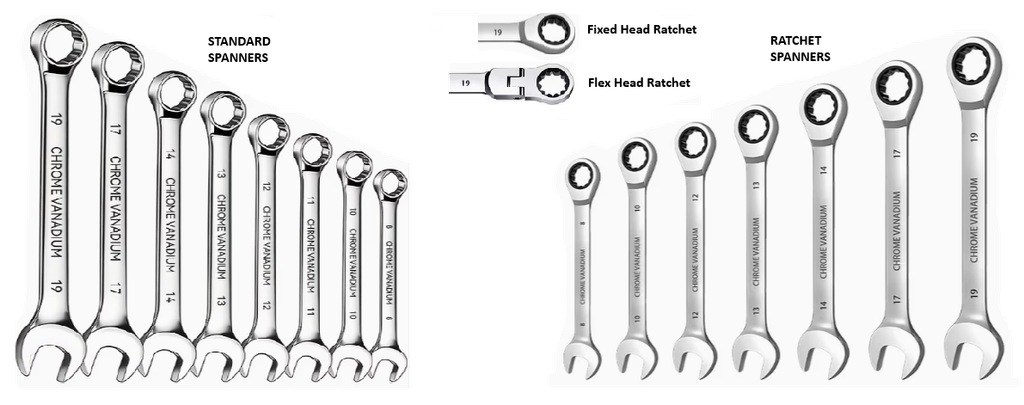
There are several types of spanners available, but a metric combination spanner set is the best choice for karting. These have an open-ended head at one end and a ring head at the other. It is generally cheaper to buy a complete set rather than individual spanners, so look for one that covers at least 8 mm to 19 mm.
As with socket sets, the most commonly used sizes are 8 mm, 10 mm, 13 mm, 17 mm and 19 mm.
If your budget allows, purchase a complete set and then add a second 10 mm and 13 mm spanner, as these sizes are used frequently. Alternatively, consider buying separate sets of fixed ring spanners and ratcheting ring spanners to give you greater flexibility when working on your kart.
PLIERS
A selection of gripping pliers is essential for kart maintenance.
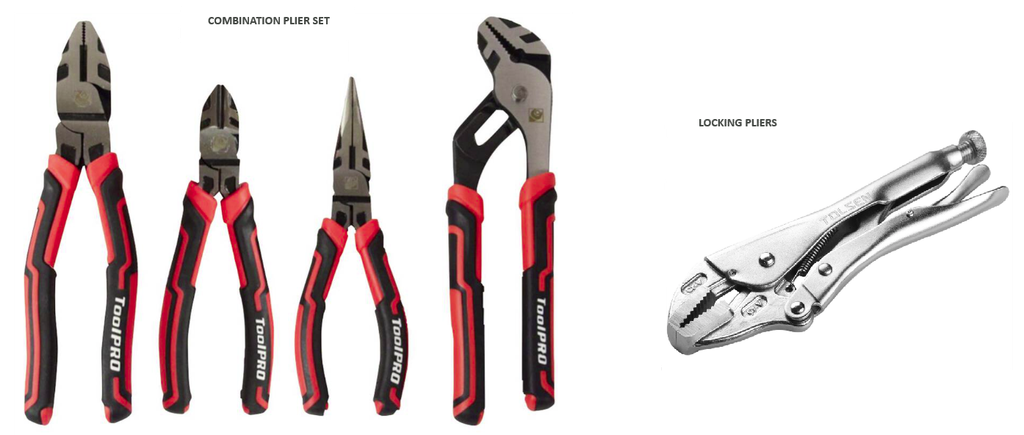
Combination pliers are the most versatile option and are useful for handling clips, springs, cable ties, wires and exhaust springs. ToolPro makes a good range of quality, affordable options.
Also consider adding a pair of 250 mm locking pliers, as pictured on the right. These are occasionally useful for gripping and holding stubborn components when other tools aren’t sufficient.
Use locking pliers with care, as they can damage or mark surfaces. Avoid using them on precision engine components or finished fasteners where damage could be costly.
TYRE PRESSURE GAUGE
Often overlooked by beginners on their first visit to the track, a tyre pressure gauge is a mandatory tool and an essential part of your pre-track checks. Although digital gauges may sound appealing, they are generally overkill for karting. They rely on batteries and can be less robust due to their electronic components and LCD screens. An analogue tyre pressure gauge is usually the better choice, as it is typically more durable and requires no batteries.
Choose a gauge with the following features:
- Pressure range: 0–30 PSI (preferred, higher ok)
- Graduations: Clearly marked in 0.5 PSI increments or finer.
- Bleed valve: A quick-release bleed button for easily reducing tyre pressure.
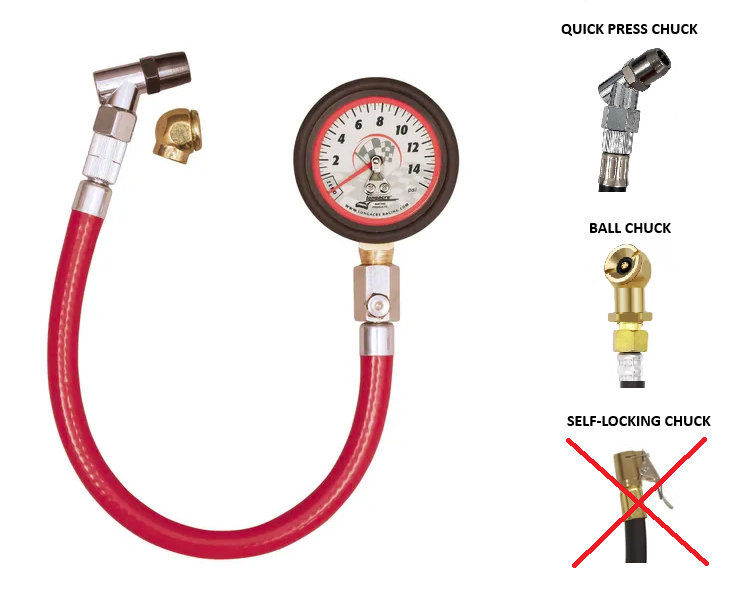
- Tyre valve connection: A quick-press chuck is preferred, while a ball-foot chuck is an acceptable alternative. Avoid self-locking chucks, as shown in the image.
You will generally run your kart tyres at around 8–14 PSI, depending on the tyre type, track conditions and setup. Always check your tyre pressures before heading out on track and adjust them as necessary.
OTHER SMALL ESSENTIALS
The following are a list of other small essential items that should be included in your toolkit.
- Cables ties (various sizes)
- Electrical tape
- Workshop Rags
- Small torch
- Permanent marker
- Ear Plugs
Keep an eye out for part 2 coming soon!
Leave a Reply