
Unfortunately identifying the details on the karts homologation plate is not always consistent. Note that plates can vary greatly, especially for older karts, however this is the generic layout:
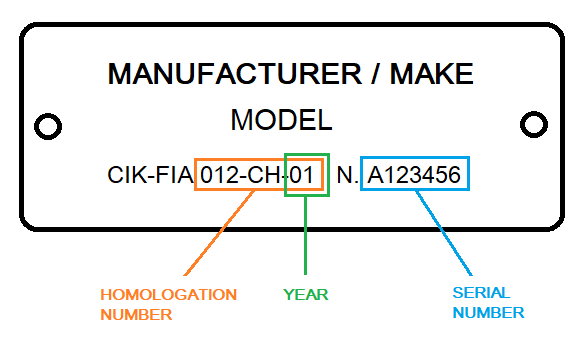
To add to the confusion, later karts (approximately 2018 onwards) use the third part of the homologation number as a model identifier. This is an arbitrary number assigned by the manufacturer. As classic karts pre-date 2005, the year alone should be sufficient to identify their approximate age. Keep in mind that this is the homologation expiry date, rather than the year the kart was manufactured. For confirmation, it is always best to search using the full homologation number.
CIK-FIA = Commission Internationale de Karting, or International Karting Commission, which is the governing body for international kart racing
012 = refers to the manufacturer (eg: 007 = Birel Art, 012 = OTK etc)
CH = refers to the type of product (see list below)
01 = refers to the last year (expiry) of homologation (for older karts) or often the model (for newer karts)
Homologation number reference (for example ‘CH’ in the above image refers to the Chassis)
A = Ignition
C = Carburetor
CA = Bodywork
CH = Chassis
EX-SI = Exhaust silencer
FR = Brake Systems
M = Engines
P = Tires
SA = Intake Silencer (Airbox)
EXAMPLE 1
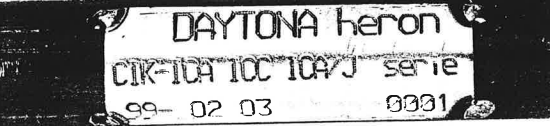
The CRG Heron Plate below, the 99 indicates that the homologation is valid until 1999. From our research, it shows that pre-2000’s homologation for a chassis was typically 3 years so in the case below the homologation was valid from 1997-1999. For post-2000’s, it appears the homologation period was extended by default to 5 years (see image at bottom of this post for an example) Also note that some manufacturers may apply for an extension to the homologation period, so some may even be greater than 5 years! It is always best to verify with the manufacturer where possible.
EXAMPLE 2
Here is an example of my Maranello Kart chassis, with homologation plate laid out as follows:
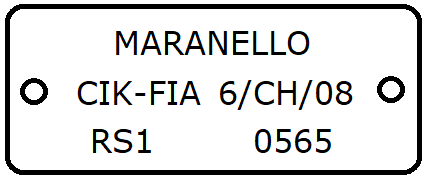
From the above, we can deduce that this is a Maranello Kart Chassis, with its homologation expiry in 2008. The model is an “RS1” and its serial number is “0565”. From further research online, homologation for this chassis ran from 2003 – 2008. The only way to determine the actual build date was to contact Maranello and provide them the serial number. From this, they replied indicating that this particular chassis was built in 2004.
For older karts, and to confuse things even more the ’94 chassis homologation lists the year of homologation, so a Swiss Hutless classic has the homologation number 94/117 which wasn’t required to be on the kart so isn’t really of use to anyone; instead it has “CIK 31” stamped on it. There is no pattern to this stamped number as a CRG Kalifornia from the same homolagation period is stamped with “Kali 99 A”

In summary, unfortunately the homologation plate can often only be used as a guide and further research into the kart (or contacting the manufacturer and providing them the serial number) may be required to accurately identify the build year.
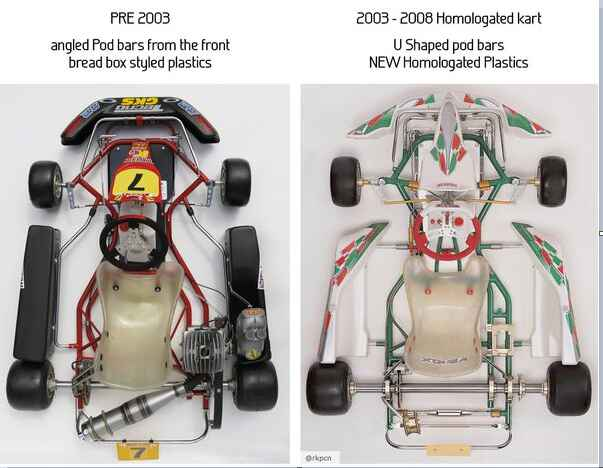
This may further assist with identification.
Also see a complete guide to CIK-FIA approvals (requires paid membership to TKART magazine or signup for a free 30 day trial)